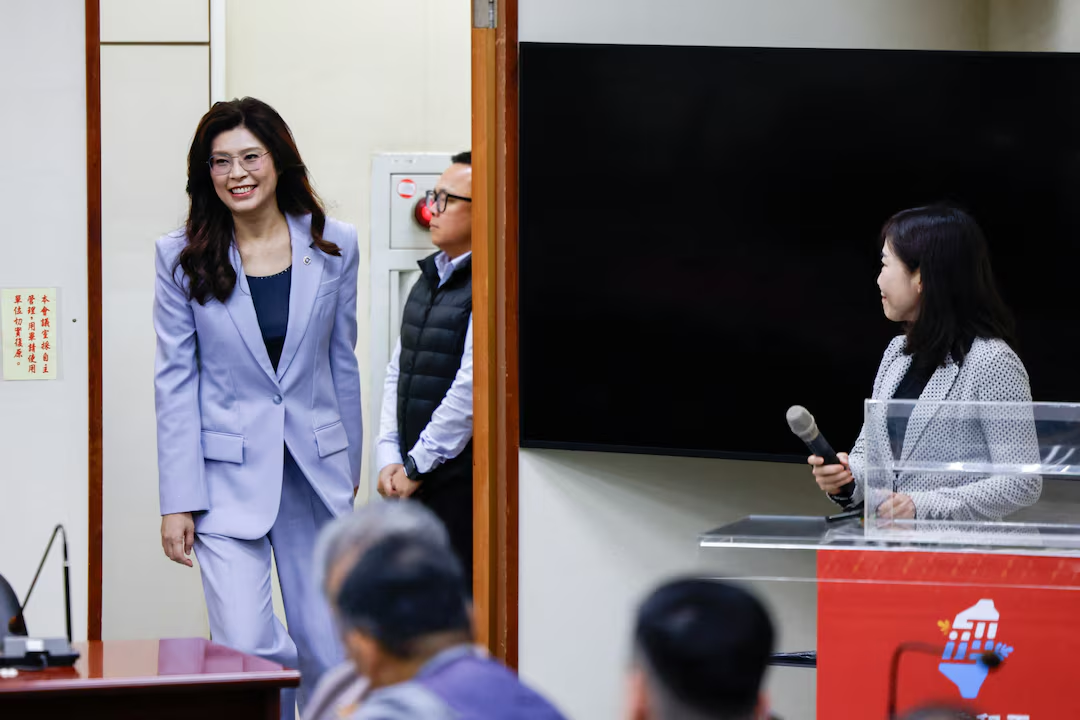
Taiwan’s opposition leader Cheng Li-wun has pledged to pursue reconciliation with China during a symbolic visit to the mausoleum of Sun Yat-sen in the eastern city of Nanjing.
Cheng, chairwoman of the Kuomintang KMT, made the remarks on Wednesday while laying a wreath at the tomb of Sun, revered as the founding father of the Republic of China. She invoked his ideals of unity, equality, and inclusiveness, calling for peaceful engagement across the Taiwan Strait.
“We should work together to promote reconciliation and unity... and create regional prosperity and peace,” Cheng said, emphasising dialogue over confrontation.
Her visit comes at a time of heightened tensions between Taiwan and China, with Beijing increasing military pressure on the self-ruled island, which it considers its own territory. The trip also coincides with political deadlock in Taiwan, where the opposition-controlled parliament has stalled a proposed $40 billion defence spending plan.
Sun Yat-sen, who overthrew China’s last imperial dynasty and founded the Republic of China in 1912, remains a rare figure respected by both Taiwan and China. While Taiwan honours him as its founding father, China’s Communist Party regards him as a national hero and revolutionary pioneer.
During her speech, Cheng acknowledged Taiwan’s democratic progress while also referencing its past under martial law. She also praised mainland China’s development, calling it “beyond expectations.”
However, her outreach has drawn criticism from the ruling Democratic Progressive Party DPP. Party officials argued that peace cannot rely solely on dialogue and stressed the importance of strengthening Taiwan’s defence capabilities.
Meanwhile, Taiwan President Lai Ching-te has maintained that only the people of Taiwan can decide the island’s future. China, however, refuses to engage with Lai, labeling him a separatist.
Security remained tight throughout Cheng’s visit, which analysts see as both a diplomatic gesture and a politically sensitive move aimed at easing cross-strait tensions while balancing domestic political pressures.
The visit highlights the deep divisions within Taiwan over how to handle relations with China, as well as Beijing’s ongoing strategy of combining military pressure with political outreach.



.jpg)
.jpg)






.jpg)